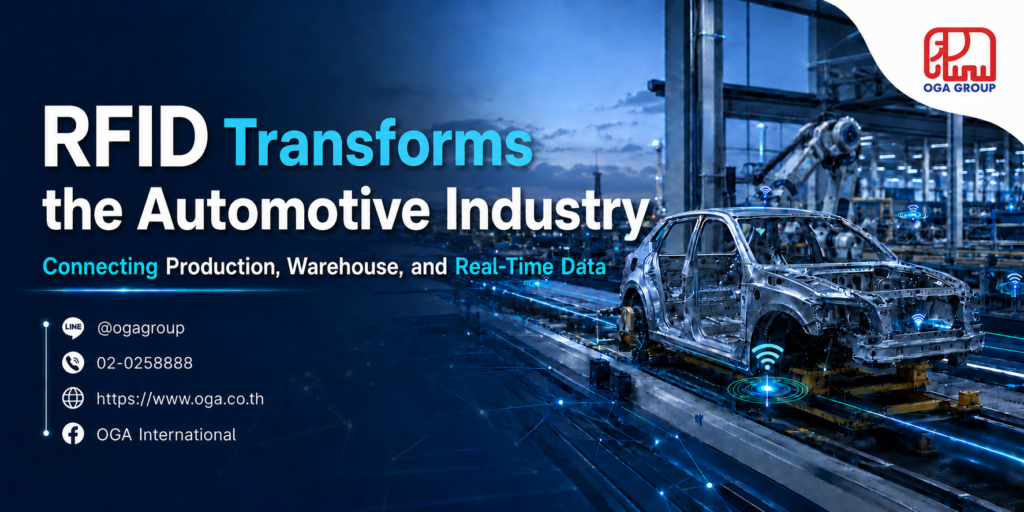
The automotive industry is one of Thailand’s most important manufacturing sectors, especially in the Eastern Economic Corridor, or EEC. This area includes Chonburi, Rayong, and Chachoengsao, where many automotive manufacturers, parts suppliers, and logistics providers are located.
As production becomes faster and more complex, factories need better visibility, higher accuracy, and real-time data. This is where RFID technology plays an important role.
RFID in automotive industry helps manufacturers track parts, vehicles, pallets, and production processes automatically. It reduces manual work, improves accuracy, and supports smart factory operations.
What Is RFID and How Does It Work?
RFID stands for Radio Frequency Identification. It uses radio waves to identify and track objects through RFID tags and RFID readers.
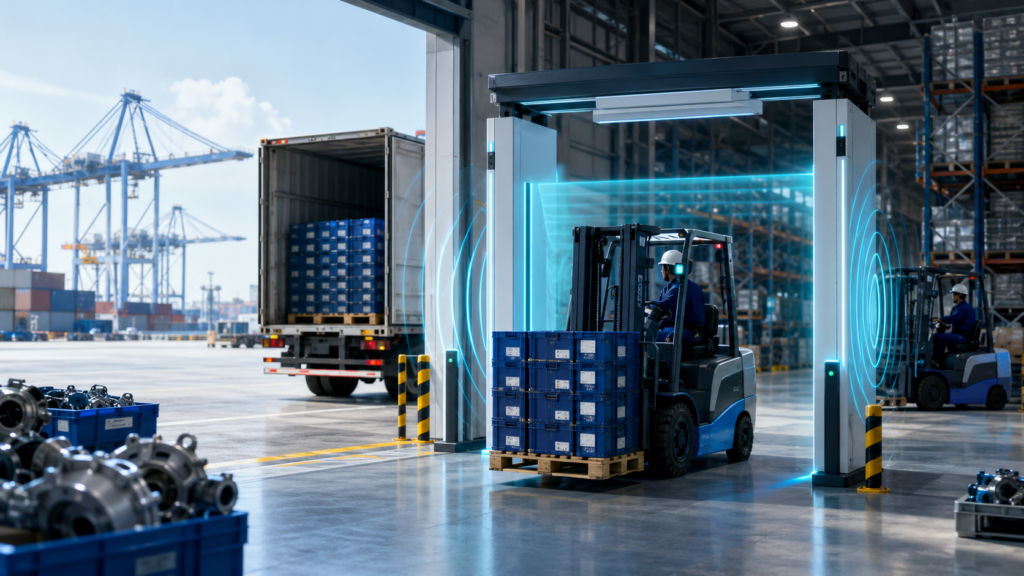
Unlike traditional barcode scanning, RFID does not require direct line-of-sight. A reader can detect RFID tags automatically when items pass through a specific area, such as a production line, warehouse gate, or loading zone.
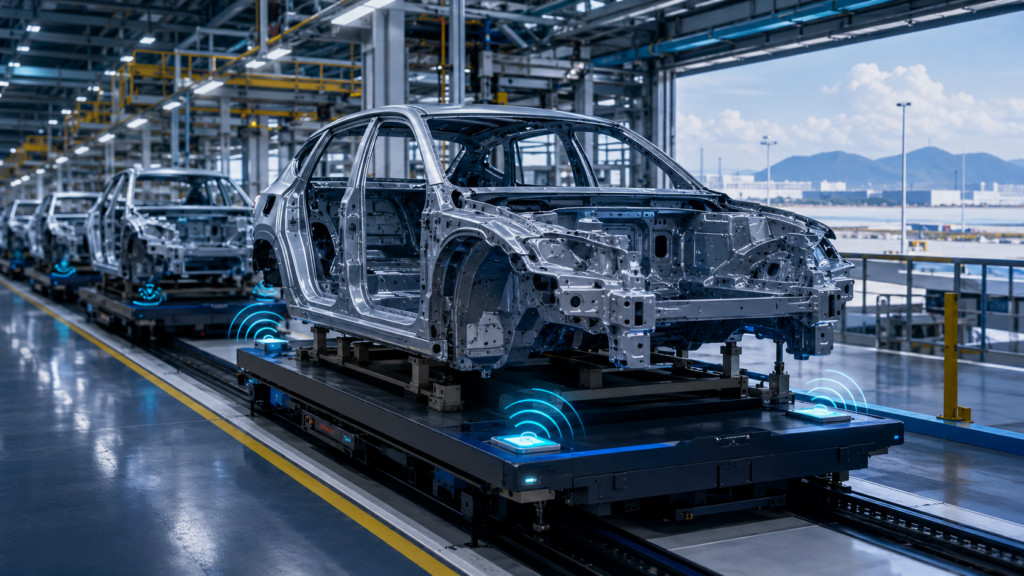
In automotive factories, RFID tags can be attached to car bodies, skids, parts containers, pallets, or returnable transport items. The data is then sent to systems such as ERP, WMS, or cloud platforms.
Real-Time Work-in-Process Tracking
One of the key benefits of RFID in automotive industry is Work-in-Process Tracking, or WIP Tracking.
In an automotive assembly line, each vehicle or component moves through many production stages. RFID allows the system to identify where each item is, which process has been completed, and what should happen next.
This helps production teams monitor the line in real time. It also reduces missing parts, incorrect assembly, and delays caused by unclear production status.
Better Parts Management with Just-In-Time Operations
Automotive factories often rely on Just-In-Time, or JIT, production. This means parts must arrive at the right place, at the right time, and in the right quantity.
RFID gates can automatically scan parts or pallets when they enter the warehouse or production area. The system can update receiving data immediately and connect it with ERP or warehouse systems.
This reduces manual scanning, speeds up receiving processes, and improves inventory accuracy.
Reducing Human Error
Manual data entry and item-by-item scanning can lead to mistakes. For example, staff may scan the wrong item, miss a box, or enter incorrect quantities.
RFID helps reduce these errors by reading multiple tags automatically. It also supports more reliable data collection across production and warehouse operations.
For automotive factories that require high quality control, accurate data is essential. RFID makes it easier to trace parts, review production history, and solve problems quickly.

Why RFID Fits the EEC Area
The EEC is a key area for next-generation automotive manufacturing in Thailand, especially electric vehicles, smart logistics, and automation.
The region also has strong infrastructure for 5G, IoT, cloud systems, and industrial technology. This makes it suitable for RFID implementation.
In addition, many factories and system integrators in the EEC already understand automation technology. This allows companies to adopt RFID more smoothly and connect it with existing systems.
Key Benefits of RFID in Automotive Industry
RFID technology provides many advantages for automotive manufacturers, including:
- Real-time production visibility
- Faster parts receiving and warehouse operations
- Reduced manual errors
- Better traceability
- Improved inventory accuracy
- Integration with ERP, WMS, IoT, and cloud systems
- Support for smart factory transformation
- More efficient supply chain management
RFID in automotive industry is more than a tracking tool. It is a technology that helps factories improve production accuracy, warehouse efficiency, and real-time data visibility.
For automotive manufacturers in Thailand’s EEC, RFID can be a strong foundation for smart factory development. It helps connect production, warehouse, and business systems into one accurate and reliable data flow.
By starting with key areas such as WIP tracking, parts receiving, or warehouse automation, companies can improve efficiency and prepare their operations for the future of automotive manufacturing.
Contact OGA International
Line Official: @ogagroup
Tel: 02-0258888
Website: https://www.oga.co.th